

The Mission of Maldives Customs Service has been to ‘safeguard national border and facilitate legitimate cross border movement through service excellence and innovation to enhance socio-economic prosperity’.
By providing economic stability and guaranteeing a smooth passage of movements in goods, it not only helps in enhancing trade across borders but thwart crimes, trade imbalance and society unity of nations.
The first account of Maldives Customs Service is evident in the 1980s although the Maldives Customs Service officially became a member of the World Customs Organization on 8th September 1995, during the tenure of Mr. Hussain Manikfan.
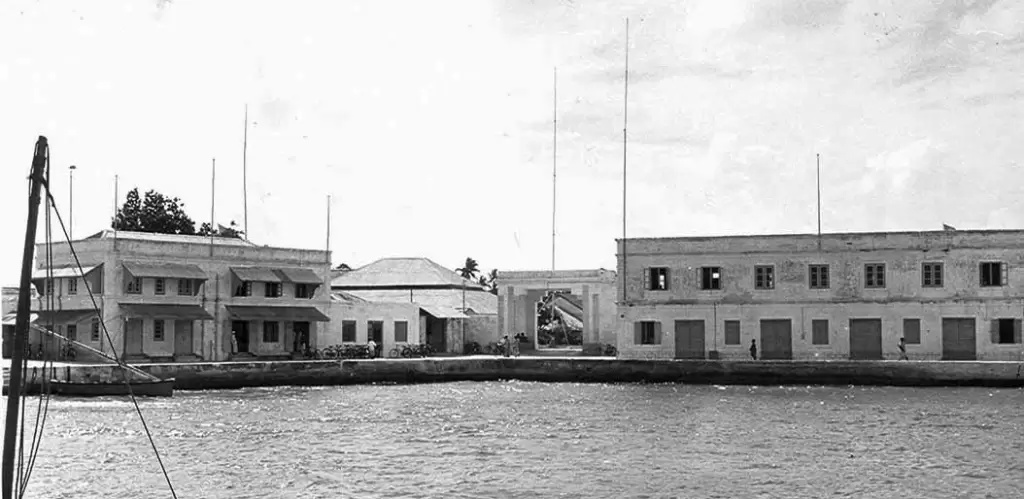
Former Customs Building named Ibraaheemiyya, in the 1980s (Credits: Hassan Hameed)
With limited information for educators and learners alike, our team at Litus sat down for a meeting with fellow staff from Customs Maldives Service to understand how the entity has triumphed over the years and overcome challenges along the way.
Looking back over the years, how far has Customs Maldives Service come in terms of digital
transformation?
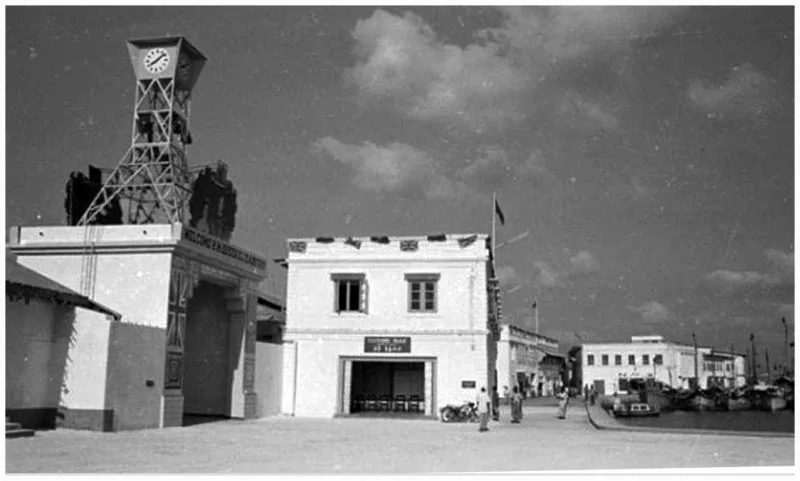
An eastern view of Ibraaheemiyya and the gateway captured on 13th March 1972 at the time of Queen Elizabeth II’s visit (Credits: Hassan Hameed)
Over the years, notable advancements have been made by the customs administration in overcoming risks and ensuring smooth movement of operations.
“Earlier we used to have an archive for storing documents and other important files. You could see staff rummaging through large files to find the relevant document or to simply log information. For approvals, for example, one might be required to sign 100 forms on a daily basis but things operate much more efficiently now”. Remarks Faruhaad Dawood,
the Senior Superintendent of Sea Cargo Examination.
Previously, filing and storing documents, filling the necessary forms and gaining approvals required manual work. From monitoring attendance to fulfilling audit requirements, a lot of time was lost.
“We completely rely on a paperless system now, that’s efficient in not only storing and record-keeping information but also saves us a lot of time and unnecessary costs”, he emphasizes.
“When I first started work here, all we did was guess work. We had no X-ray machines, no way to trace luggage or items specifically. So, we would use chalk to identify baggage alone”, a senior veteran from Seaport Surveillance and & Interdiction, Ahmed Safwath explains.
“Times have changed, we have hand-scan/tracing machines and what’s more- we have staff leading staff, a limited resource then- in physical observations, monitoring and surveillance, which is a massive growth”, he states.
As per the Superintendent of Valuation and Procedures, Mohamed Zubair, ‘there has been a profound shift over the years in handling risk management, processing documentation overall as a whole. We have a capable risk management system overall and our hope is that in future, this system will become far more holistic and would take into account majority of checks and balances within the processes”, he says.
Apart from this, the current system ‘ASYCUDA’ facilitates easier operations in importing and exporting goods shippers, brokers and customers alike. Similarly, the HIRAAS System consisting of risk channels simplifies documentation and internal processes to expedite clearance of goods.
He adds that, “in future we aim to make it a holistic system that would integrate system checks and balances to monitor processes”.
How do you ensure transparency in Administration and Operations?
State entities face numerous concerns over their image through allegations and public scrutiny. Ensuring transparent practices provides accountability and minimizes oversights.
“Our Strategic Plan is being revised at the moment and we are bringing changes to our Structure for the public to see” speaks Farhad. “All this information will be available on our website, or accessible for perusal on our public domain. Our valuations are
transparent, our figures and calculations are based on the World Customs Organization valuations standard, under agreement. Import, export percentages can be seen on the website.”
In the year 2020, the Integrity and Professional Standards Section was established with the sole purpose to fight corruption, misconduct and unethical practices.
The formation of the integrity and standards committee paved a new way for the administration to ensure transparency in order to minimize any corrupt practices.
Another area of public scrutiny is over price concerns.
The Maldives Customs follows valuations as per the WTO standard, an impartial and uniform mechanism to levy duties.
“We follow the guidelines set by the World Customs Organization in agreement with WTO standards. Valuation changes will occur based merely on these. If a customer believe we are overcharging or prices seem unreasonable, they can always appeal. The
documents required for the process is available on our website. This is a national level committee and consists of several stages.
The Appeal Committee addresses concerns over complaints relating to Customs transactions. The committee is led by the Chairperson and Vice-chairperson along with seven other custom officials or appointees.
“Previously, our mission was to deliver world class customs service. Now our mission is to be ‘Trusted and leading’ which means we are setting an example on an international level. We believe we are good and can set an example to other countries”, states
Mohamed Zubair.
As a complete state entity, what do you take most pride in today?
One of the things that Maldives Customs take pride in is their dedication to training and ensuring the advancements of employees.
We have created certified international experts who educate and share their knowledge overseas. Our accredited staff who have been trained directly from the World Customs organization brings us great pride, as they are working under world-class standards”, speaks Zubair.
“Our recent Assistant Commissioner is now working in the World Custom Organization under their technical team. As an entity, we are forward thinking and we don’t believe in growth without the growth of our own employees. Enhancing the existing skills of our staff is a priority”, he adds.
“Five years ago, our Strategic Plan indicated that we aimed to achieve ‘World-class customs’ in providing service. But now our objectives are clear; we aim to be the most trusted and leading customs service provider. This means we have the capacity to set ourselves apart on an international level. We believe we have potential to serve well”, he adds.
A ground-breaking development in this regard took place in the year 2020 in commemoration of the International Women’s Day by the then-Minister of Gender, Family and Social Services, Hon. Aishath Mohamed Didi with the assignment of female
officers under sea cargo inspection. This was a remarkable initiative to minimize barriers to women and ensure equality in the workplace.
It was also highlighted that the administration is always looking to find innovative solutions in order to solve existing challenges. Planning ahead and ensuring their strategic goals are well-aligned with the mission of the entity, is thus critical to their work.


