


The future of freight looks bleak without considering the environmental impact when going forward. Within the transportation sector, shipping accounts for 11% of carbon emissions in the world, ranking in third place globally.
By 2050, the International Maritime Organization’s target of reducing emissions by 50% seems far off. The goal to protect the environment from the overuse of fuel and emissions cannot be overlooked.
It is essential to thus, review and shift existing practices within the industry.
Traditionally, most companies have had linear plans in their supply chain operations from production to distribution, and disposal. But attention has now shifted to following a circular flow in supply chain, that includes 5 R’s: Reduce, Repair. Resell, Refurbish and Recycle. In a way, the products are reintroduced into a new life cycle without being disposed of.
Recent discussions that went underway at the Global Maritime Forum’s Annual Summit in London this year have shown the industry is ready to compromise and find ways to address these issues.
However, in order to meet its full potential, one cannot do without the other. The circular economy must meet the potential for adopting reverse logistics. This means, logistics-businesses could foresee processing returned back goods back to the market without losing its value. According to Allied Market Research, the projected reverse logistics market is valued at 958.3 billion by 2028. It is all about preserving value.
Another resourceful way to tackle the issue could also be by route planning. Modern technology facilitates pre-planning with the use of assistance systems and digital tools to improve transport and make logistical operations more efficient.
By integrating this into fleet management to attain real-time monitoring and analyse data, more smarter decisions in planning can be established; in turn, increasing sustainable outcomes.
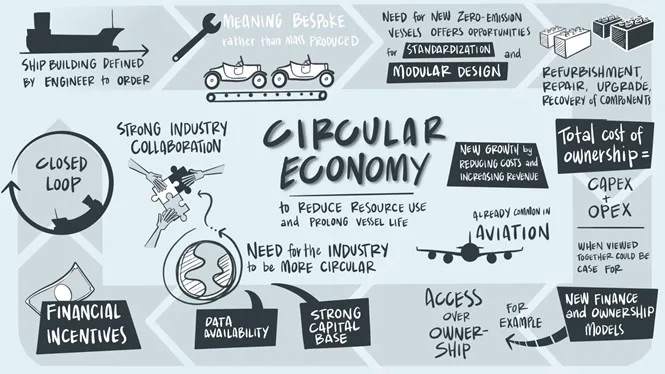
Scribing: Circular economy
Some companies such as the Continental, tire manufacturer in Hanover, Germany have started the process of replacing the use of fossil fuels with alternatives like rapeseed oil, cellulose fibres and other plant-based oils which can reduce crude oil consumption.
Perhaps we can learn from other industries such as these in the automotive industry that adopts transitions from one energy source to another and maximise efficiency.


